
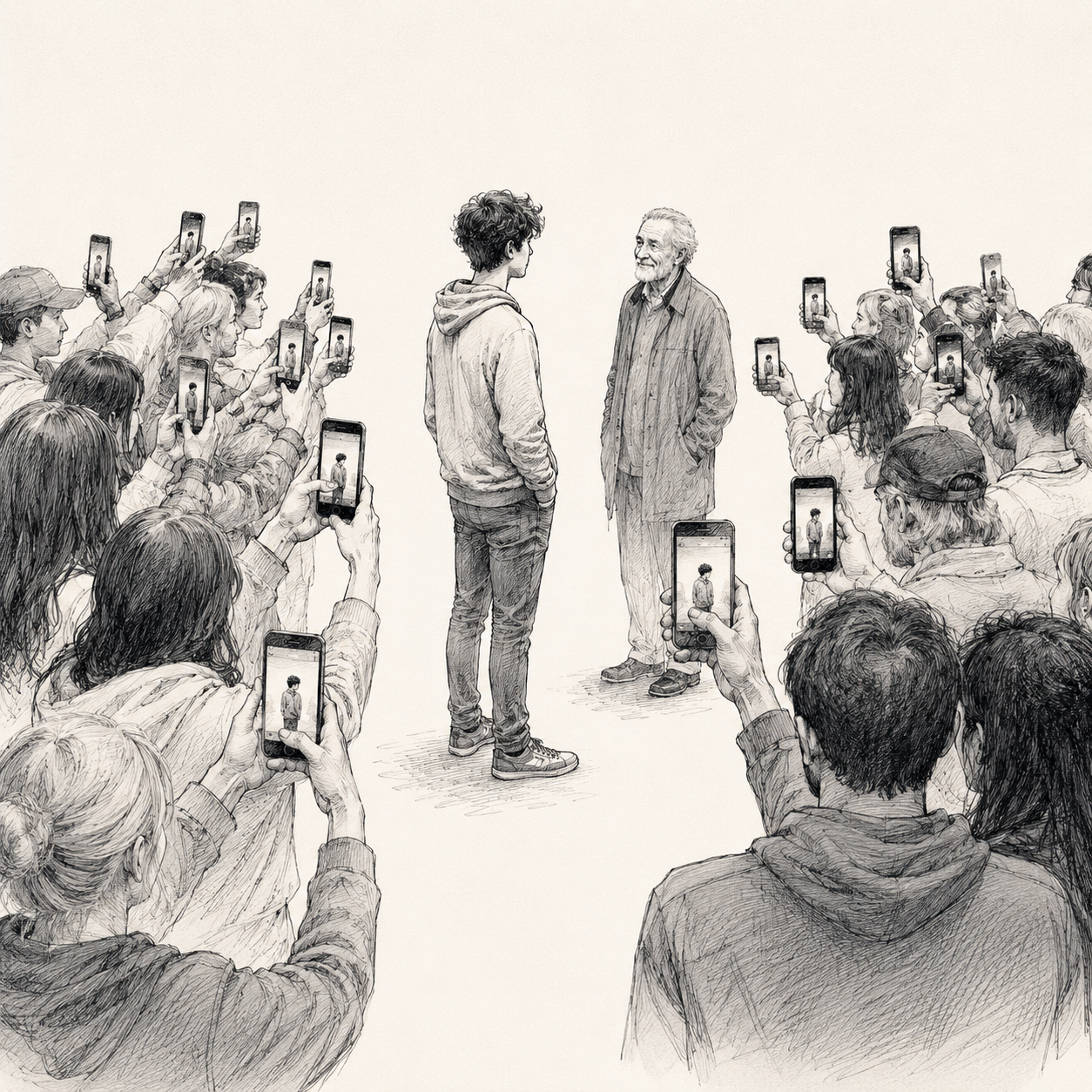
What The Odyssey knows about being known, not just seen.
We live in the most watched and least known generation in human history. Every gesture is curated, every moment is a potential post, and somewhere in the performance we’ve lost the thing Homer’s audience took for granted — that being truly recognized by another person requires proof no filter can fake.
I recently went to see the 2026 summer blockbuster The Odyssey. I was intrigued by the different scenes and how they were shared with us through the recollections of different characters — Odysseus’s story told and retold, filtered through whoever happened to be doing the remembering at the time. I didn’t think much of it walking in. I couldn’t stop thinking about it walking out.
If you haven’t seen it, I recommend it — not for its cinematic brilliance, whatever that actually means, and not for perfect casting either. I’m no expert, but I’ll go ahead and assume Matt Damon looks exactly like a Greek city-state king from a few thousand years back. Not for the screenplay, though I’ll say this much: it was easy to listen to. Not even for the CGI, which apparently has some people online very upset about the Cyclops — really, that’s the hill we’re dying on? The real reason I’d recommend it is that if you’re anything like me, it will dredge up a curiosity you didn’t know you had. This is a three-thousand-year-old work of literature. Surviving that long makes it unique in a way only a handful of other works can claim, and it made me suspect there’s more going on in it than the Cyclops, the Sirens, and a wooden horse. Something in there is still telling us about ourselves. Surprisingly, we may not be all that different from the first people who heard it.
Here’s what stuck with me walking out of that theater: nobody in it got Odysseus’s story straight from Odysseus. We got him through a bard’s song, through a son’s half-formed memory of a father he barely knew, through a wife’s decade of imagining a man who might already be dead. A life, pieced together through other people’s memory of you — because your own account of yourself is never the whole picture, and sometimes it isn’t even the most accurate one. That’s not how I’ve usually thought about identity. I tend to assume I’m the world’s leading expert on who I am. The movie quietly argued otherwise, and three thousand years before anyone had a camera to prove it, Homer seemed to already know it.
Upon leaving the theater I wondered just how accurate the film was to Homer’s original, and more importantly, just how relevant the original still is to our modern society. So, like I often do, I went hunting for a “free” translation — something I could read on my own time, at my own pace, without a lot of scholarly throat-clearing between me and the story. And frankly, I didn’t find one that was all that easy to read. The free ones I found were free the way a lot of things online are free — technically available, but built for a reader with more patience for footnotes than I had that week. Or, as often as not, free to help sell you something else.
There’s a small irony I didn’t notice until later. I went looking for something accessible and found instead a poem written for an entirely different kind of audience, in an entirely different economy of attention, than the one I’m living in now. Homer’s first listeners sat through the whole thing in one sitting, by firelight, with nowhere else to be and no second screen in their lap. I was trying to read it in stolen minutes between everything else my day was asking of me. The distance between his world and mine turned out to be a lot more than just language.
That’s what drove me to have an AI chat with Claude, asking whether I could get my own translation, from the original Greek, one built for a reader like me. In relatively short order, Claude and I worked through a brand-new translation together — not scholarly, not trying to win an award, just trying to let Homer say what he was actually saying, in language a tired man could read after supper.
I should say up front — I’m writing this having read only part of that translation so far, not the whole thing. What follows isn’t the view of a man who has finished the book. It’s closer to a running account of what’s surfacing as I go, and I suspect that’s honestly a better vantage point for this project than pretending I’ve already got it all figured out. A book about being seen honestly probably shouldn’t open with me pretending to know more than I do.
Even so, in the part I have read, I started noticing something I wasn’t looking for. Scene after scene, Homer isn’t just telling an adventure story. He’s asking, over and over, in a dozen different disguises, what it actually takes for one person to be truly known by another. And underneath that, I’m starting to suspect there’s a second, quieter question — whether Odysseus, for all his cleverness, actually knows himself. “Who am I?” might be the real question sitting underneath the whole poem, and it’s one most of us end up asking ourselves at some point, whether we ever say it out loud or not. I don’t know yet how far the book runs with that thread. I intend to keep pulling on it.
That question — being known, and knowing yourself — feels a lot more urgent to me now than it probably would have felt to Homer’s original audience. We are the most photographed generation that has ever lived, and I’m not sure we’re the best known. A man can post his whole day and still go to bed feeling like nobody actually saw him do it. We reach for the phone before a feeling has even finished happening — before we’ve felt it ourselves, we’re already deciding how to show it to somebody else. There’s a particular kind of tired that comes from being visible all day and unknown by nightfall, and I don’t think it has a name yet, but I’d wager most people reading this have felt it.
What makes Homer useful here, oddly enough, is exactly how far away he is from all of it. Nobody in the Odyssey has a filter. Nobody can curate the story before it reaches the next town. When Odysseus is finally recognized — not once, but several times, by several different people, each in a completely different way — it’s never because he announced himself convincingly. It’s because someone noticed a detail that couldn’t be faked. A scar. A knowledge of how a bed was built into a living tree, something only a husband could know. Even a dog, blind and dying, knows him on smell alone before his own household figures it out. In a world with no way to perform recognition, Homer’s scenes become almost clinical in what they reveal about what real being-known actually requires.
The film gave me a smaller version of the same idea, and it’s stuck with me since. There’s a quiet scene where Odysseus tells his men he’ll hunt for their dinner while they set off to find who lives in the cabin at the top of the hill. He goes off alone, spots a deer, takes the shot — and walks up to find he’s killed a man. It’s over almost before you register it. Then he makes his way to the same cabin, where he finds Circe, doing everything she can to get him to eat her soup, and it doesn’t take him long to work out what’s happened to his men. I haven’t gotten far enough into the translation yet to know what, if anything, Homer’s original text does with that moment; that part of the story is still ahead of me. But even just as the film plays it, there’s something worth sitting with — a man aims carefully at what he’s sure he’s looking at, and he’s wrong, twice in the same afternoon. First a deer that was a man. Then, soup that was almost him. How many times a day do the rest of us do the same thing — look right at someone and see only the shape we expected, not the person actually standing there?
So — in the manner of the other Granddaddy Can’t topics, I’ve started a new one: Granddaddy Can’t Understand the Classics.
From Odysseus weeping at his own legend sung back to him, to a dog recognizing his master when an entire household cannot, to a wife’s decade of faithfulness that nobody was watching — Homer already knew what a phone in every hand has made the rest of us forget. Each chapter will pair a passage from the epic with a short essay connecting it to a distinctly modern ache: the influencer’s curated face, the algorithm’s endless comfort, a son raising himself on tutorials instead of a mentor’s voice.
I don’t intend for this to read like a classics course. I’m not qualified to teach one, and I suspect you didn’t come here for one. I’m hoping it reads more like a mirror — three thousand years old, and still, somehow, catching the light.